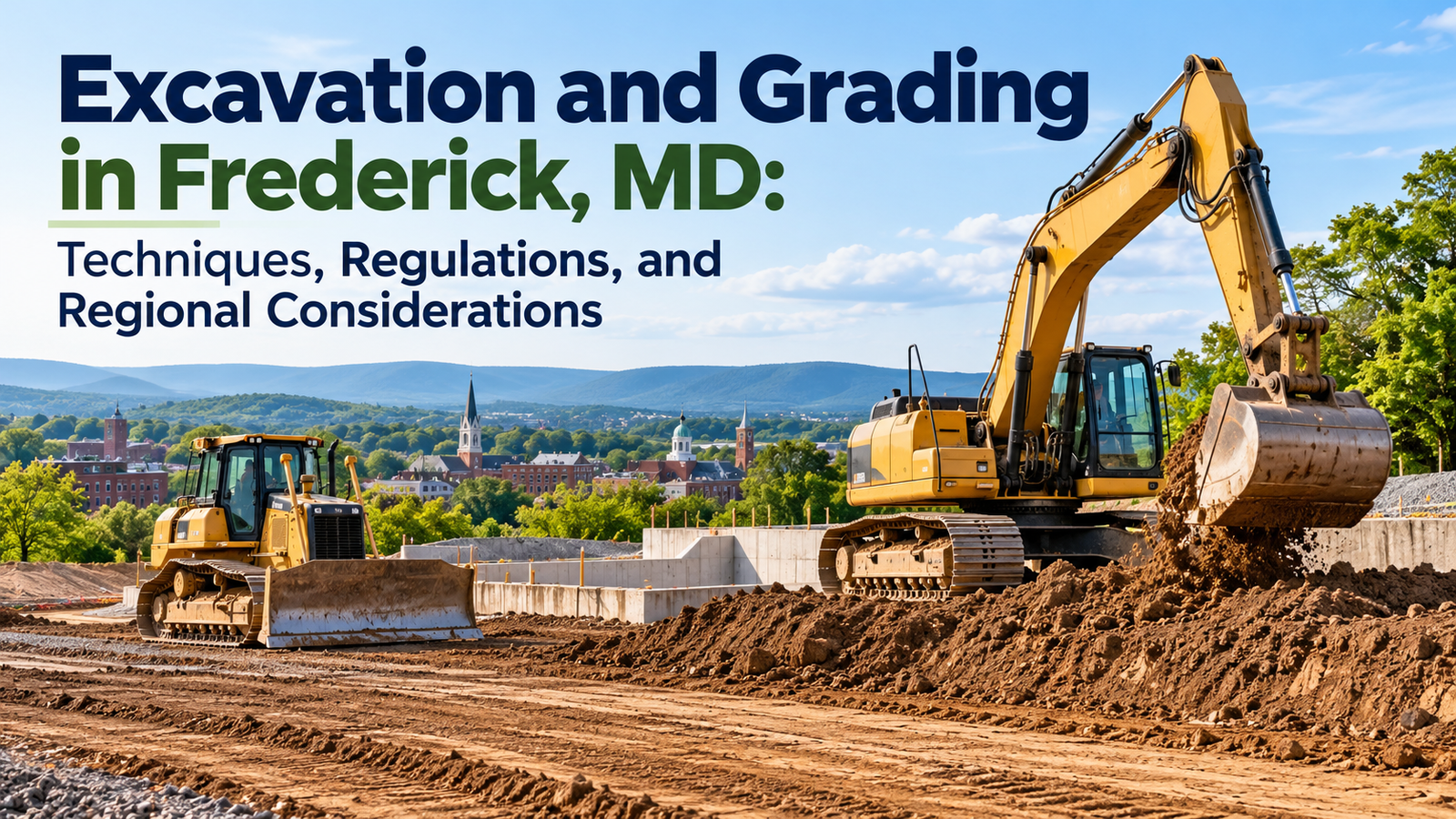
Excavation and grading are among the most fundamental earthwork operations in construction and among the most consequential. Done well, they create a stable, properly drained platform for everything that follows. Done poorly, they become the source of problems settlement, drainage failure, structural cracking that compound over the life of a project. In Frederick, Maryland, where the geology ranges from deep limestone bedrock to alluvial river bottom soils to the karst-prone terrain of the Great Valley, excavation grading Frederick require more than equipment operation. They require regional knowledge and technical precision.
The Distinction Between Excavation and Grading
Excavation refers to the cutting, removal, and relocation of earth material to create a desired subsurface condition a foundation trench, a utility corridor, a basement cavity, or a pond. Grading refers to the reshaping of the ground surface to achieve specified elevations, slopes, and drainage patterns. The two operations are closely related and often performed sequentially or simultaneously on a construction site, but they have different primary purposes and different technical standards.
Foundation excavation removes soil to a specified bearing elevation where the structural loads of the building can be adequately supported. Utility trenching excavates narrow corridors for pipe and conduit installation. Mass grading reshapes the larger site to establish design grades. Fine grading is the final precision grading to achieve exact elevations for slab, pavement, or finish landscape areas.
Frederick’s Geology and Its Effect on Excavation
The geology beneath Frederick presents a range of conditions for excavation. In the limestone valleys that characterize much of Frederick County, depth to bedrock varies considerably sometimes 20 feet or more, sometimes barely below the surface. Excavation that encounters bedrock requires rock cutting by mechanical means (hydraulic hammer, ripping, or in some cases controlled blasting) rather than bucket excavation, which significantly affects production rates and project scheduling.
Karst terrain the dissoluted limestone landscape found in portions of Frederick County creates a specific excavation hazard: the potential to open a void or sinkhole during excavation. When excavation equipment encounters a cavity in karst terrain, the ground can collapse suddenly, creating a safety hazard and a project complication. Geotechnical investigation with probing or borings before excavation begins helps identify karst features so that work plans can anticipate and address them.
Alluvial soils along the Monocacy River and its tributaries present different challenges: high groundwater, soft compressible material, and in some areas organic deposits. Excavation in these conditions requires groundwater management well points, sump pumping, or sheet pile cutoffs to maintain stable, dry working conditions. Soft alluvial soils also require over-excavation and replacement with engineered fill to achieve the bearing capacity needed for structures.
The soil survey for Frederick County identifies the dominant soil series across the county. The Hagerstown silt loam and related soils have moderate shrink-swell characteristics. The Opequon-Hagerstown complex, found in areas with shallow bedrock, presents excavation challenges where limestone bedrock is only a foot or two below the surface. Understanding which soil series underlie a specific parcel before beginning excavation design is part of the site investigation process.
Grading Design and Drainage
The primary functional goal of grading design is to direct surface water away from structures and toward designated drainage outlets. This seems simple but becomes complex on constrained sites with multiple buildings, parking areas, and pedestrian spaces all of which need to drain appropriately without directing runoff to adjacent properties or into building foundations.
Finished floor elevations are set during grading design to provide positive drainage away from the building on all sides. A minimum slope of 2 percent away from the foundation for the first 6 to 10 feet is a standard requirement of Maryland’s residential and commercial building codes. This slope must be maintained through landscaping and not compromised by soil settling around the building after construction.
Drainage swales shallow channels in the graded surface direct sheet flow to collection points. In Frederick’s development context, these swales often connect to bioretention facilities, stormwater ponds, or storm drain inlets that are part of the site’s stormwater management system. Maryland’s stormwater management requirements have become increasingly stringent since the 2000 Chesapeake Bay TMDL requirements drove state regulatory action, and Frederick County’s and the City’s development reviews reflect those requirements.
Erosion and Sediment Control During Grading
Any grading that disturbs the protective ground cover exposes bare soil to rainfall and runoff, creating sediment that can reach Frederick’s waterways. Maryland law requires that erosion and sediment controls be installed before grading begins and maintained throughout the project until permanent stabilization is achieved.
Standard erosion controls used in Frederick include silt fencing along the downhill perimeter of disturbed areas, inlet protection around storm drain inlets, construction entrances to reduce tracking of mud onto public roads, and sediment traps or basins to capture runoff from larger disturbed areas. Frederick County’s Soil Conservation District inspects active grading sites for compliance; violations can result in stop-work orders and fines.
Permanent stabilization seeding and mulching, or sodding must be established within specified timeframes after grading is complete. Temporary stabilization using straw mulch or hydroseed provides protection during the period between grading and permanent vegetation establishment. Areas that will be paved or built on do not need vegetation, but all disturbed areas outside the building and pavement footprint must be stabilized.
Utility Excavation and Trenching Safety
Utility trenching is a common form of excavation on construction sites in Frederick, for installation of water, sewer, storm drain, gas, and electrical utilities. Trench safety is governed by OSHA’s Construction Standard 29 CFR 1926 Subpart P, which requires that trenches deeper than 5 feet either be sloped to the angle of repose for the soil type, shored with engineered shoring systems, or protected with a trench box.
In Frederick’s cohesive (clay and silt) soils, vertical trench walls are possible for short periods in dry conditions, but groundwater, vibration from nearby traffic, and the time-dependent weakening of cohesive soils make unprotected deep trenches hazardous. Trench collapses are a leading cause of construction fatalities; compliant cave-in protection is required, not optional.
Miss Utility notification is required at least 48 hours (two business days) before any excavation in Maryland. The call to 811 triggers notification to all utility operators in the area, who mark their underground facilities with colored flags or paint before work begins. Damaging an unmarked utility that was not properly located is the operator’s responsibility; damaging a marked utility is the excavator’s.
Frequently Asked Questions: Excavation and Grading in Frederick
What happens when rock is encountered during excavation in Frederick?
Encountering bedrock during excavation requires either hydraulic hammer (hoe ram) breaking, ripping with a dozer shank in weathered rock, or controlled blasting in hard massive rock. Rock excavation is significantly more expensive and slower than soil excavation. Subsurface investigation before project design geotechnical borings or probing helps identify rock depth so that the project budget and schedule reflect actual conditions.
How does Frederick County’s karst geology affect excavation projects?
Karst voids and dissolution features in Frederick’s limestone geology can be encountered during excavation without warning. When a cavity is opened, it must be investigated and addressed either grouting, bridging with structural fill, or redesigning the foundation to span the feature. Geotechnical investigation before excavation begins is the best way to identify potential karst issues and plan for them rather than discovering them as surprises during construction.
What is the difference between cut and fill in grading?
Cut refers to removing material from areas that are too high relative to design grade; fill refers to placing material in areas that are too low. Balanced earthwork projects import or export as little material as possible by matching cut volumes to fill needs on the same site. Fill placed in structural areas must be compacted in lifts to engineered density specifications it cannot simply be pushed into low spots.
Do I need a permit for excavation in Frederick City?
Permits are required for excavation associated with construction projects. Building permits authorize foundation excavation; grading permits are required for larger earth disturbance. Utility work in the public right-of-way requires right-of-way permits from the City of Frederick Department of Public Works. All excavation requires Miss Utility (811) notification at least 48 hours before digging begins.